MODERNISM IN THE MEADOW CITY?
GREATER NEW MEXICO
J. Padilla
7/1/2026


Las Vegas, New Mexico, known as the ‘Meadow City,’ is famous for its 900+ historic buildings—Victorian, Queen Anne, Italianate, Prairie, Beaux Arts, and Southwestern adobe styles across “new” and “old” town, or "east" and "west" as locals know it. You get a good sampling of historic architecture driving through the residential areas of 6th through 8th streets, and of course, on Bridge Street and the plaza itself.
But modernist architecture? Pues, qué es eso?
On a spring weekend trip back to Las Vegas to visit friends and family, while exploring the NM Highlands University campus, I found it—midcentury details hiding in plain sight: clean lines, bold geometry, warm brick, breeze block, tiled pops of orange and teal, and original light fixtures if you look closely.
The Music Building (below) stood out with its folded-plate roofline, expansive windows, and light fixtures. I would have loved to have seen the inside, but alas, it was a weekend and it was all locked up.
As I ventured toward student housing, it appeared that most of the newer dorm buildings were boxy, generic, pseudo-New Mexico/Territorial aesthetic. However, several of the residence hall buildings built in the early to mid 1960s were still standing, still occupied, and in seeming good condition. Best of all, they oozed with modernist design and details. Below is a sampling of some of these structures with their beautiful reddish-brown materials, crisp lines and fixtures.
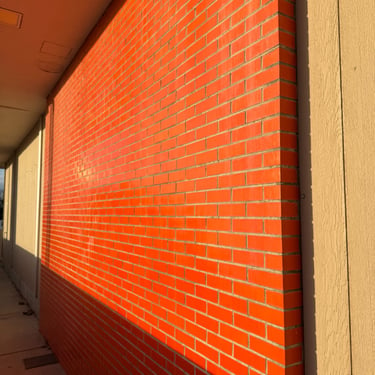
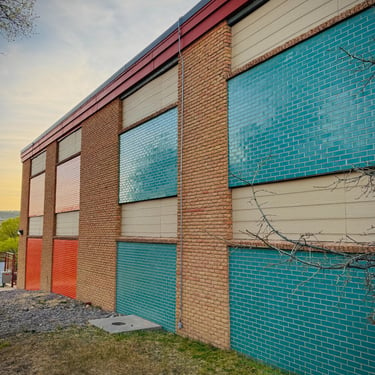
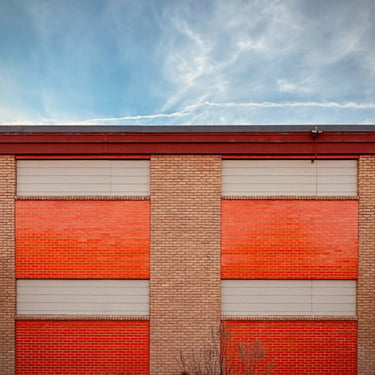
A now-abandoned building (below), which I believe formerly housed the cafeteria, still stands strong with its beautiful orange and teal tilework and brick. I try to imagine how much more impressive this structure looked before all of the windows were boarded up. These colorful brick walls would certainly qualify as an Instagrammable spot, but it remains off-the-radar. I did manage to take some rare selfies, especially since orange is my favorite color!


After a vibrant dose of the orange and teal tilework, I was equally blown away by the massive wall of white breeze block accenting the Gregg House (married student housing) building. It was built in 1961, but the plaque only listed NMHU administrators and no architect.
Double-diamond designed white concrete walls adorned the sides of several other student housing buildings, and the geometric lines of Connor Hall were also impressive. I thought the images below were particularly striking in black-and-white to emphasize the form and structure of the design.

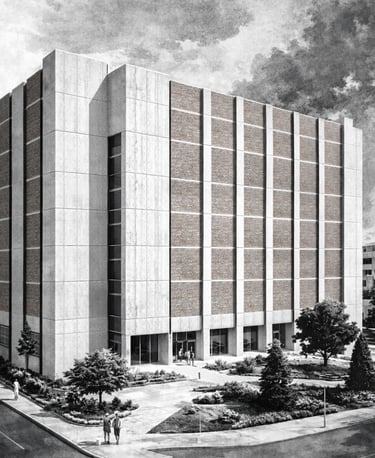
An interesting footnote is that NMHU once had the tallest building in northern NM—a nine-story $1.2M modernist dormitory completed in 1969. It was made of brick and exposed concrete and designed by renowned Santa Fe architect, Philippe Register. The Oct 6, 1967 Las Vegas Optic also reported it would include 160 double rooms, a large dining hall and elevators. In other reading, I learned that the project took about a year longer than anticipated due to the complexity of building such a large structure.


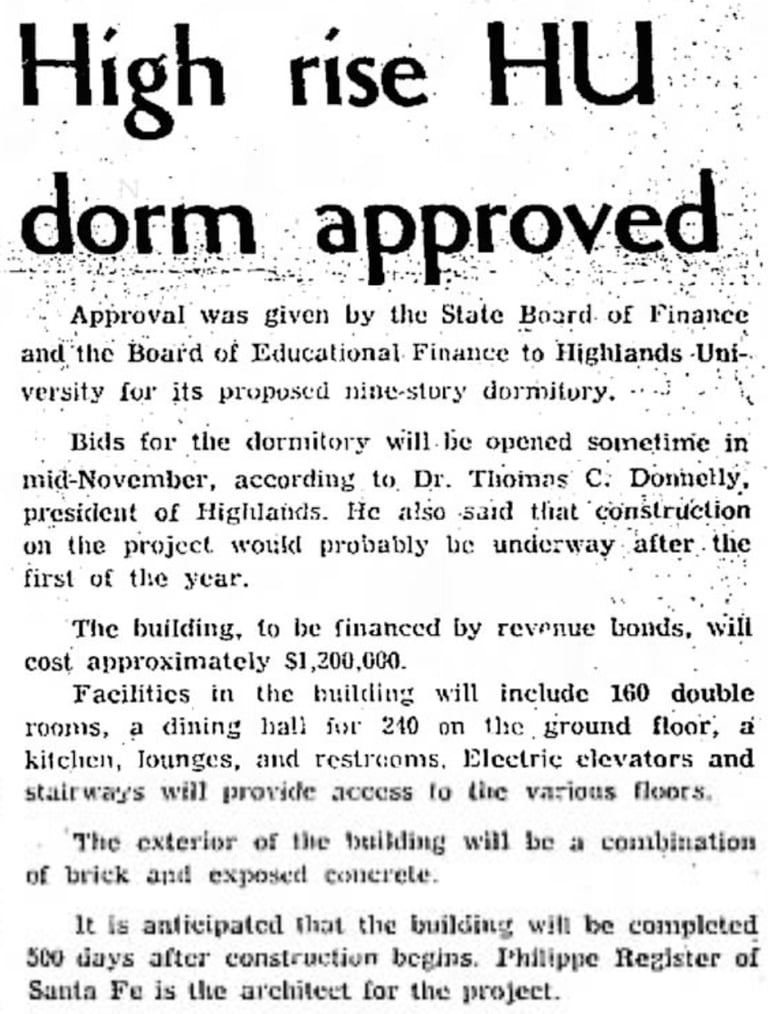

I did manage to find an old ad for an electrical company and an architectural rendering (below) of the nine-story dorm building. And, I do actually vividly remember the 'high-rise' structure itself since I was a kid, and it certainly stood out in this small city where the Sangre de Cristo Mountains meet the great plains. Sadly, after about three decades of use, it was demolished in 2007 due to safety concerns.
It’s striking to realize how much I once passed without really seeing. These modernist buildings were there all along, purposeful, and, at the time, in better condition than they are now.
In my (weak) defense, my days were spent at the edge of campus, mostly inside the psychology building, focused on coursework and running a rat behavior lab (a story for another time). Architecture barely registered.
Looking back, I feel both a sense of having missed something and a real appreciation that some of these structures remain. With time, experience, and a more attentive eye, I’m finally able to see them for what they are.
_______
Sources: Las Vegas Daily Optic: 8/3/67, 10/6/67, 10/25/67; 9/5/07; NM Archited, Jan/Feb 1969.